 Bordeaux Wine Day Tour
Saint-Émilion Village: What to See and How a Visit Works
Saint-Émilion is the wine village most visitors to Bordeaux put first on their list, and for good reason. It is a UNESCO World Heritage site, it sits on a limestone hill planted with Merlot, and it is about 40 km from the city, which makes a day trip easy. This guide covers the village itself: what it is, its history and the Jurade, and what to see one sight at a time, with the official visit details, hours and ticket prices for each. For the fuller wine side, the appellation and the 2022 classification, see the Saint-Émilion wine guide. If you would rather let someone drive, compare every Bordeaux wine day tour on the homepage before you book.
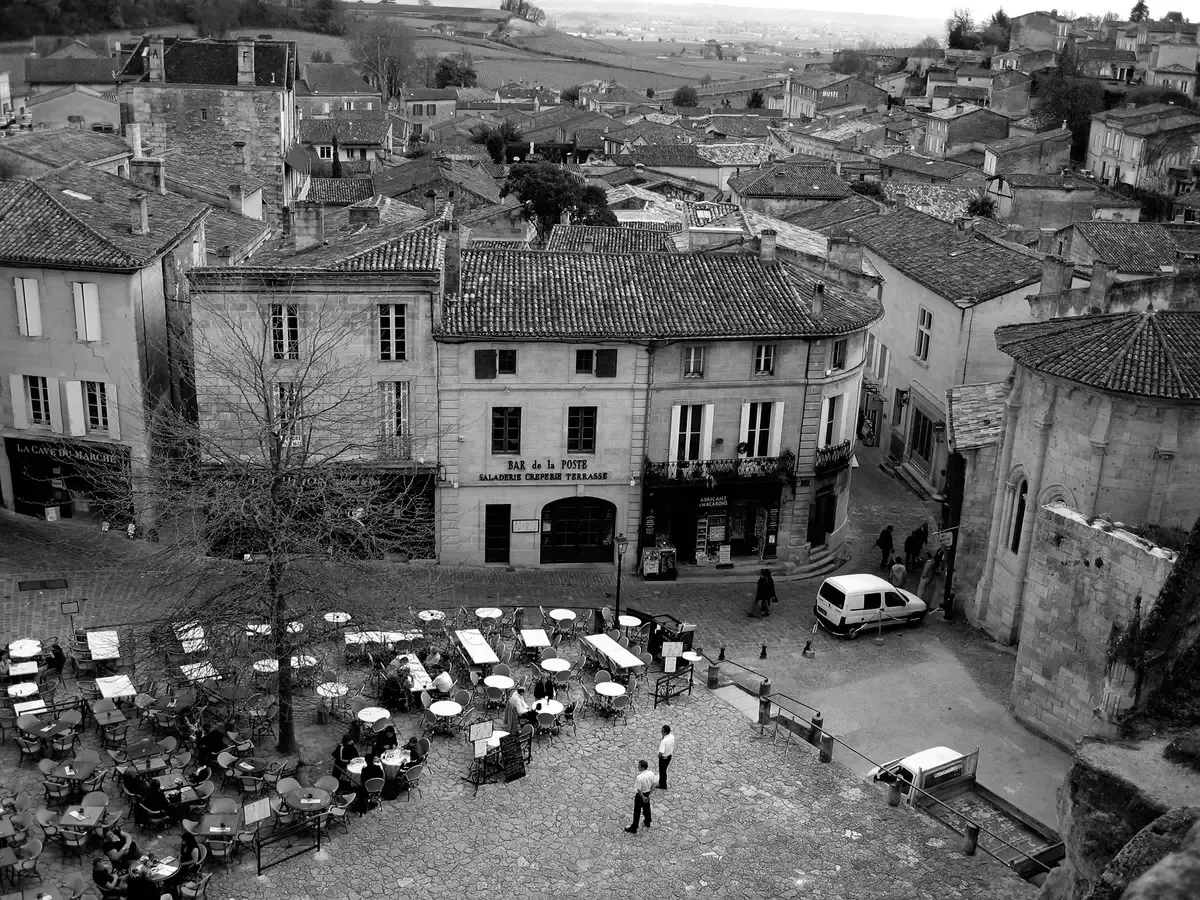
The market square of Saint-Émilion seen from above. Photo: Olivier Aumage, CC BY-SA 2.0 fr, via Wikimedia Commons
Quick answer Saint-Émilion in short
Saint-Émilion is a medieval hilltop wine village about 40 km east of Bordeaux, and its vineyard landscape was added to the UNESCO World Heritage List in December 1999, the first vineyard ever listed as a cultural landscape. The village has about 1,600 residents, 14 historic monuments and close to a million visitors a year, so come early or late in the day. The highlight is the monolithic church, an underground church carved from limestone, open only on guided tours. You can reach it by train in about 30 minutes or on a half-day minibus tour.
Key takeaways
- The easiest way to pair the village with a château visit and a tasting is the half-day Saint-Émilion wine tour with village walk and Grand Cru Classé tasting, 4 to 4.5 hours from $95.
- Doing it yourself is simple: trains from Bordeaux take about 30 minutes and cost from €9.50. Full times, fares and the walk from the station are in the Bordeaux to Saint-Émilion guide.
- The underground church cannot be visited alone. Tickets, hours and the tour route are covered in the monolithic church of Saint-Émilion guide.
- Most people need a half day in the village. Stay overnight if you want château visits and a long lunch as well.
Saint-Émilion at a Glance
Before you climb the first cobbled lane, it helps to know what kind of place Saint-Émilion is and how big the numbers around it actually are.
The Key Figures
These are the figures that shape a visit, drawn from the Saint-Émilion tourist office, UNESCO listings and standard references. Where sources disagree, both figures are given so you know the range. The population matters for one practical reason: a village of roughly 1,600 residents hosting close to a million visitors a year gets crowded, which is why early mornings and late afternoons are the calm times.
The monument count explains why one visit rarely covers everything, and the appellation area shows how much vineyard surrounds the small built core.
| Fact | Figure | Source note |
|---|---|---|
| UNESCO inscription | December 1999 | First vineyard landscape listed as a cultural landscape, tourist office |
| Communes in the UNESCO Jurisdiction | 8 | Saint-Émilion plus 7 neighbours, tourist office |
| Village population | 1,608 (2023), about 1,876 per the tourist office | Wikipedia gives the lower figure, the tourist office the higher one |
| Saint-Émilion appellation area | About 5,400 ha, roughly 6% of Bordeaux's vineyard | Wikipedia, the tourist office UNESCO page says about 5,000 ha of vines |
| Visitors a year | Close to one million | Tourist office press kit |
| Historic monuments in the village | 14, of which 11 are classified | Tourist office press kit |
| Weekly market day | Tuesday | Tourist office market page, one blog says Wednesday |
| Bell tower height and steps | 68 m with 196 steps (tourist office), other sources say 53 m or 70 m | Tourist office, French Wikipedia and Guide Tourisme France disagree |
A Hermit, Limestone and the Jurade
The village takes its name from Emilion, a Breton hermit who settled in a natural cave in the limestone cliff in the 8th century and died in 767 according to Guide Bordeaux Gironde. His disciples dug the first underground passages around his tomb, and pilgrims kept coming. That is the origin of everything you see today, because the local Asteria limestone, about 30 million years old, was soft enough to quarry and carve. Churches, dwellings and whole underground galleries were cut straight out of the rock. The stone also built the town above, and the quarries beneath it now serve as cellars.
The second pillar of the village is the Jurade, the wine brotherhood founded in 1199 by King John of England through the charter of 8 July 1199. It was dissolved at the Revolution and reconstituted by winegrowers in 1948. Today about 140 jurats in red robes protect the appellation's interests. They proclaim the Judgment of the New Wine on the third Sunday of June, from the King's Tower, and the Ban des Vendanges, the harvest opening, on the third Sunday of September.
Sources: Saint-Émilion Tourist Office, Bordeaux wine, Wikipedia
What to See in the Village
The village holds 14 historic monuments in a few steep streets, so a sight-by-sight plan beats wandering. Here are the ones worth your time, with the official visit details.
The Monolithic Church
This is the reason many people come. The church was carved downward out of the limestone plateau at the start of the 12th century, probably as a reliquary church for pilgrims around the tomb of Saint Emilion. It measures 38 m long and 12 m high, with roughly 15,000 cubic metres of rock removed, and it counts as one of the largest underground churches in Europe.
Access is strictly by guided tour from the tourist office, never on your own. The tour covers four monuments: the hermitage, the Trinity Chapel with its medieval paintings, the catacombs and the church itself. It lasts about 45 minutes to 1 hour and costs €11 per adult.
Two sentences cannot do it justice, so see the full monolithic church of Saint-Émilion guide for the route, the booking rules and the photography ban.
The Bell Tower
The bell tower rises above the church and the market square, and the tourist office puts it at 68 m with 196 steps, the highest bell tower in Gironde after Saint-Michel in Bordeaux. Other references give 53 m or 70 m, so treat the height as disputed, but the climb and the 360 degree view are not. It was built between the 12th and 15th centuries, with Gothic openings added in the 14th century and a spire in the 16th.
The climb costs €2 per person, needs at least 2 visitors for safety, and is not included in the underground tour ticket. You borrow the key from the tourist office, and an unaccompanied visit takes about 30 minutes on average.
The King's Tower (Tour Du Roy)
This Romanesque keep inside the ramparts is the only one still intact in Gironde, standing 32 m from its lowest terrace to the top on a rock mass hollowed by caves and quarries. Historians disagree on its date: 1224 under Louis VIII or 1237 under Henry III of England. It served as a defensive citadel until the late 1300s and as the town hall until the mid 1600s.
Today you climb 118 steps to a roof with a full view over the town and the vineyards. Guide Tourisme France lists it at €2 for adults, free under 6, with seasonal hours, and this price is single-source, so confirm on site. This is also where the Jurade proclaims the Judgment of the New Wine on the third Sunday of June.
The Collegiate Church and Its Cloister
The collegiate church on Place Pierre Meyrat is the big church you see at the top of the village, and it is free to visit, open daily from 8:00 to 20:00 according to Guide Tourisme France. The nave and porch are 12th century, the chancel 14th century, and a college of canons following the rule of Saint Augustine lived here from the 12th to the 18th century. The church and cloister were classified as historic monuments in 1840.
Inside there is a classified organ built in 1892 by Gabriel Cavaillé-Coll and restored in 2014. The cloister beside the church is a quiet Romanesque courtyard, and because entry costs nothing and hours are long, this is the easiest monument to fit around a fixed underground tour slot.
The Cordeliers Cloister
The Cordeliers cloister at 2 bis rue de la Porte Brunet is a ruined Franciscan convent with a working second life. The friars first settled outside the walls, were damaged in the Hundred Years War, asked for protection inside the walls in 1337, received permission in 1338 and papal approval in 1343. The Revolution closed the monastery and it stood empty for decades.
Today it is a private sparkling wine cellar, with about 3 km of underground galleries held at around 12 C where crémant matures. It is a paid visit, not a free monument. The tourist office lists a walking tour of about 40 minutes, ending with a tasting of the cellar's sparkling wine and a Saint-Émilion macaron, with tours in English and Spanish.
The Ramparts and Porte Brunet
The ramparts date from the 12th century under English rule and once enclosed more than 18 hectares. The tourist office press kit says there were seven gates and that only the Porte Brunet survives, though one local guide text counts six, so the gate total is disputed. The surviving gate gives its name to the street where the Cordeliers cloister stands, and it is the best single place to picture the medieval enclosure.
The town's steep cobbled alleys, called tertres, and its stepped lanes, the escalettes, run between the ramparts and the upper town. The historic centre is pedestrian-only, the limestone steps get slippery after rain, and sturdy shoes are advised. The tourist office's own one-hour guided walk covers these lanes and the ramparts if you want the route explained.
The Grandes Murailles and the Market Square
The Grandes Murailles at Place des Créneaux are the remnant of a huge 13th-century Dominican convent. The Dominicans arrived in 1262 and settled outside the walls, and the convent was destroyed for strategic reasons at the start of the Hundred Years War. What remains is a tall fragment of wall, now surrounded by the vines of Château Les Grandes Murailles.
A short walk away is the Halle du Marché, a Gothic former grain hall that became the seat of the Jurade in the 18th century. The weekly market fills the village on Tuesday according to the tourist office, though one travel blog says Wednesday, so check locally. Nearby, look for the Maison de la Cadène, the only half-timbered house in the village, with a facade from the early 16th century.
Saint-Émilion, the Most Beautiful Wine Region
The village, its lanes and the vineyards around it. Third-party video by Roamaroo. This site did not shoot it and has no relationship with the creator.
The Wine Behind the Village
The village lends its name to one of Bordeaux's best known appellations, a vineyard of about 5,400 ha that covers roughly 6% of the region's plantings.
The 2022 Classification
The Saint-Émilion classification began in 1955 and is updated about every ten years, with INAO overseeing the process. The 2022 edition has three tiers and 85 ranked estates in total. It made news for two reasons: Château Figeac was promoted to the top tier, joining Château Pavie, and four big names withdrew rather than take part. Ausone, Cheval Blanc, Angélus and La Gaffelière are absent from the 2022 list, so a missing famous name does not mean the wine failed. The table below gives the 2022 count by tier.
The appellation also has a second name on labels, Saint-Émilion Grand Cru, which is a separate appellation rather than a classification rank. Between them they sit inside a tourist office area that names 12 appellations, including the four satellites and Lalande de Pomerol.
| Tier | Count in 2022 | Examples |
|---|---|---|
| Premier Grand Cru Classé A | 2 | Château Pavie, Château Figeac |
| Premier Grand Cru Classé B | 12 | not stated estate by estate in the sources |
| Grand Cru Classé | 71 | not stated estate by estate in the sources |
Merlot Country and the Satellites
The Right Bank is Merlot country. A typical Saint-Émilion blend runs about 60% Merlot with Cabernet Franc and Cabernet Sauvignon making up the rest, and the three varieties are the appellation's permitted backbone. Merlot thrives on the cold clay soils here and ripens up to two weeks earlier than Cabernet Sauvignon, while Cabernet Franc plays a bigger role on this bank than in the Médoc. The vineyard sits on limestone, the same rock the village is carved from.
Four satellite appellations sit north of the town and have been able to add the Saint-Émilion name since 1936: Montagne, Saint-Georges, Puisseguin and Lussac. Wines from the satellites carry the Saint-Émilion name after the commune name, as in Lussac-Saint-Émilion or Montagne-Saint-Émilion.
A guided tour handles the château visit and tasting for you. Three examples: the Saint-Émilion Village and Grand Cru Half Day at $95, the Saint-Émilion Half Day, 8 Wines at $106, and the Saint-Émilion Afternoon, Two Grands Crus at $119.90. All three include a village stop as well as the tastings.
If you want to go deeper into the neighbours, Pomerol and its Merlot sit next door in the Pomerol wine guide, and the full map of appellations is in Bordeaux wine regions. The homepage comparison of Bordeaux wine day tours has the full line-up side by side.
Planning a Day in Saint-Émilion
A few practical details decide whether the day runs smoothly: the market calendar, the shoes on your feet and where the car goes.
Market Day and Macarons
The weekly market is on Tuesday according to the tourist office market page, though a travel blog puts it on Wednesday, so check locally on arrival. Times vary by season. In summer there are also evening producers' markets at Parc Guadet, running 18:00 to 23:00 on the listed dates in the tourist office calendar.
The local macaron is not the Parisian kind. It is a single plain cookie, crisp outside and soft inside, made from sweet and bitter almonds, egg white and sugar. The recipe has been tied to the village since 1620 and to the Ursuline convent founded that year to educate local girls. The tourist office lists Nadia Fermigier as the holder of the original recipe. A box travels well and makes the most defensible souvenir in the village.
Steep Lanes, Shoes and Parking
The village is built on slopes and its streets show it. The steep alleys are called tertres and the stepped lanes escalettes, and the historic centre is pedestrian-only with cobbles and limestone steps that turn slippery after rain. Sturdy shoes matter more than stylish ones. If you want the layout explained, the tourist office runs a one-hour guided walk along the ramparts and through the tertres and escalettes.
Drivers should stay out of the centre. The free Gendarmerie car park sits near the town, and the paid car parks around the collegiate church in the upper town and at Place Bouqueyre in the lower town charge €2 an hour between 9:00 and 12:00 and 14:00 to 19:00, with a 5-hour maximum, payable by the PayByPhone or FlowBird apps. Coaches pay €20 a day at the Villemaurine lot. One guide advises arriving before 10:00 in peak season to find a space near the tourist office.
How Long You Need and How to Get There
One day is enough for the highlights of the historic centre, and one comparison guide calls Saint-Émilion a half-day stop. A Medoc trip needs a full day, this one does not. If you want château visits and a proper lunch on top of the monuments, staying over changes the maths.
The train from Bordeaux Saint-Jean takes about 30 minutes and the station sits 1.5 to 2 km below the village, a walk of roughly 20 to 30 minutes uphill. Tickets start from €9.50 by TER. The full timetable, fares and the walk from the station are covered in Bordeaux to Saint-Émilion. By road it is about 41 to 42 km and 37 minutes by car, or 45 to 50 minutes in traffic.
Staying the Night
The village has four kinds of beds, and two bigger bases sit nearby.
Where to Sleep
The tourist office lists campsites, hotels, guest rooms and gîtes or furnished rentals in Saint-Émilion. Inside the medieval walls you find the Logis de la Cadène with 8 rooms, the Badon Boutique Hotel and Hôtel de Pavie across its houses. Vineyard hotels outside the walls include the 5-star Château Hôtel Grand Barrail and the 4-star La Villa des Vignes.
Sleeping over is the way to fit château visits and lunch around the monuments. Libourne, 7 km away with about 25,000 residents and a TGV-linked station, works as a practical base. Or use Bordeaux itself and reach the village by train in about 30 minutes.
Room Lists by Base
Each link opens the live room list for that base. The village puts the vineyards outside your door, Libourne sits 7 km away on the main line with a station, and central Bordeaux is where almost every wine day tour starts.
Saint-Émilion village
- Suits
- Evenings in the village after the day visitors leave, and vineyards on foot
The village is steep and cobbled, so ask about car access and stairs before booking.
See stays in Saint-Émilion villageLibourne
- Suits
- A cheaper base on the Paris to Bordeaux TGV line
TGV services from Paris stop at Libourne, 7 km from Saint-Émilion.
See stays in LibourneBordeaux, Quinconces
- Suits
- Day tours to both banks, which meet around Place des Quinconces
Tram lines B and C stop at Quinconces, the usual meeting point for the tours.
See stays in Bordeaux, QuinconcesSaint-Émilion Questions
Is Saint-Émilion a good place to visit?
Yes, if you like history with your wine. The village draws close to a million visitors a year, holds 14 historic monuments of which 11 are classified, and its Jurisdiction was the first vineyard landscape inscribed as a UNESCO cultural landscape in 1999. Plan a half day for the centre, more if you add tastings. The sight-by-sight details are in What to See in the Village.
How do I get to Saint-Émilion from Bordeaux?
The train is the simplest option, about 30 minutes from Bordeaux Saint-Jean with tickets from €9.50, followed by a 20 to 30 minute uphill walk from the station. Driving takes about 37 to 50 minutes and parking costs €2 an hour in the paid lots. Every option, timetable and fare is set out in Bordeaux to Saint-Émilion.
What kind of wine is Saint-Émilion?
It is red wine, mostly Merlot at about 60% of a typical blend, with Cabernet Franc and Cabernet Sauvignon behind it, grown on limestone and clay. The appellation covers about 5,400 ha and its classification was revised in 2022 with 85 ranked estates. The tiers are broken down in the 2022 classification section above.
Do I need to book the underground church tour?
Yes, access to the monolithic church is strictly by guided tour and booking in advance is mandatory, daily all year except 25 December and 1 January. The tour covers four monuments, costs €11 per adult for groups of 1 to 9 and lasts about an hour. The full history and visiting details are in the guide to the monolithic church of Saint-Émilion.
What should I wear in Saint-Émilion?
Sturdy shoes. The historic centre is pedestrian-only with steep cobbled tertres and limestone escalettes that get slippery after rain, and monuments such as the bell tower involve 196 steps. Comfortable grip beats fashion here, especially in wet weather.
Can I visit Saint-Émilion without a tour?
Yes. The train gets you there, the collegiate church and cloister are free to enter daily from 8:00 to 20:00, and the tourist office sells the underground tour at €11. The trade-off is château access, since most estates take visitors only by appointment. The half day Saint-Émilion wine tour at $95 is one way to solve the appointments.