 Bordeaux Wine Day Tour
Graves Wine: The Region South of Bordeaux
Graves wine comes from the strip of gravelly ground south of Bordeaux, on the left bank of the Garonne. It is the historic home of Château Haut-Brion, the only 1855 First Growth outside the Médoc, and of Pessac-Léognan, the appellation created in 1987 for its northern half. Pessac-Léognan makes both red and dry white, and the gravel that gave the Graves its name is the reason Cabernet Sauvignon ripens there. This guide covers the soil, the appellations, the 1953 and 1959 Graves classification and how to reach the vines from the city, by tram or on the one bookable day tour that starts in the Graves. The bookable tours are compared on Bordeaux wine day tours.
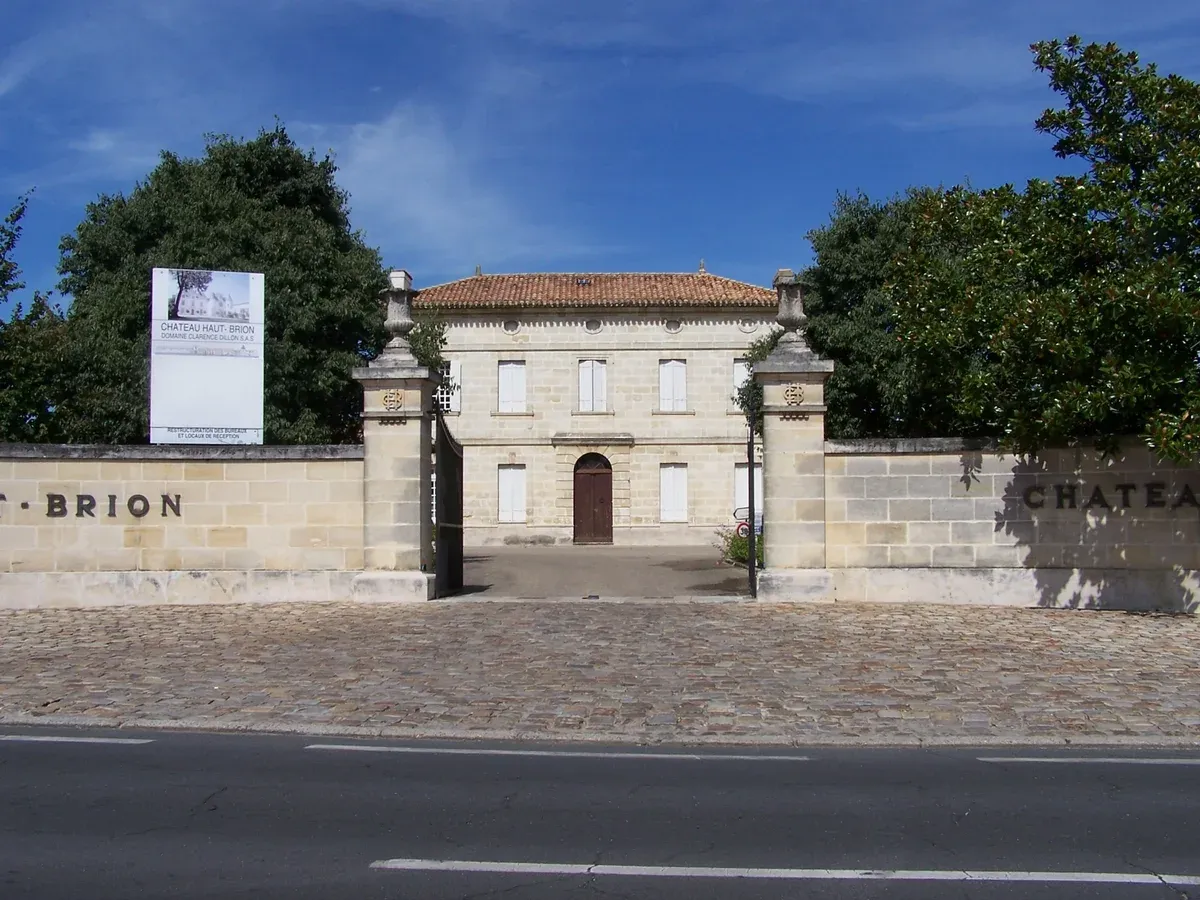
The gates of Château Haut-Brion in Pessac. Photo: Henry Salomé, CC BY-SA 4.0, via Wikimedia Commons
Quick answer Graves wine in brief
Graves wine is made on the left bank of the Garonne, upstream and south-east of Bordeaux, in an appellation of 42 communes that stretches about 55 km from the city to Langon. It takes its name from the gravel soil left by glacial deposits, and it makes both red and dry white.
Key takeaways
- The northern half became the separate Pessac-Léognan appellation in 1987, and that is where Château Haut-Brion stands, in the suburb of Pessac.
- The Graves classification dates from 1953 for reds and 1959 for whites, and all of its châteaux now sit inside Pessac-Léognan.
- The syndicate puts the Pessac-Léognan vineyards at just under 20 minutes from the city centre. A branch of tram line B ends at Pessac Centre, and weekday trams run at least every ten minutes.
- Only one bookable day tour starts in the Graves: the Graves and Saint-Émilion picnic day at $199.83. For the full line-up, compare every Bordeaux wine day tour on the homepage.
The Graves in Figures
The Graves is a single appellation with a long documented history. Graves AOC was recognised on 4 March 1937, and it counted 3,087 hectares planted in 2023.
Key Numbers for the Appellation
The table pulls together the core figures for the Graves AOC from the appellation data and the region's geography. Note the red-to-white split: 2,476 ha of red against 611 ha of white planted.
Graves also sits inside the wider Bordeaux framework of about 65 appellations and roughly 110,000 hectares of vines, by CIVB 2021 figures. Wikipedia reports the Bordeaux vineyard at 95,000 ha in 2024.
| Fact | Figure |
|---|---|
| Graves AOC recognised | 4 March 1937 |
| Communes covered | 42 |
| Shape of the appellation | about 55 km long by 10 km wide, Bordeaux to Langon |
| Planted area (2023) | 3,087 ha: 2,476 ha red, 611 ha white |
| Production (2023) | 112,981 hl from about 200 domains |
| Position | left bank of the Garonne, south-east of Bordeaux, stretching over 50 km |
| Pessac-Léognan split off | 1987 |
| Whites in Pessac-Léognan (2023) | about 18% of volume, 82% red |
The Gravel That Gives the Name
The name Graves comes from graves, the Occitan word for gravel. The soil is gravel, sand and clay laid down in alluvial terraces left by the Garonne, on ground pushed by Ice Age glacial deposits. That drainage matters. Cabernet Sauvignon buds and ripens late, typically one to two weeks after Merlot, and it thrives on well-drained gravel that stores heat and radiates it back at night. On the Left Bank generally, which includes the Graves alongside the Médoc, the typical red blend runs about 70% Cabernet Sauvignon, 15% Cabernet Franc and 15% Merlot, a near mirror image of the Right Bank where Merlot leads.
The Pessac-Léognan syndicate describes its terroir as Bordeaux gravel mixed with clay, sand and alios on hilltops with natural drainage. The Garonne eases frosts to the east and the Landes forest shelters the vines from winds to the west. For dry white, the same syndicate credits Sauvignon with structure and Sémillon with body, with a little Muscadelle. If you want to see how the Graves compares with its neighbours, the Bordeaux wine regions guide maps them all, and Sauternes lies further south-east on the Garonne.
Sources: Saint-Émilion Tourist Office, Bordeaux wine, Wikipedia
Pessac-Léognan and Haut-Brion
In 1987 the northern Graves, the part nearest the city, won its own appellation. Pessac-Léognan is now the home of every classified Graves estate, including Château Haut-Brion.
A 1987 Appellation of Ten Communes
Pessac-Léognan AOC was established in 1987, with the syndicate recording its creation in December under founding president André Lurton, and the decree dated 9 September 1987 in the classification record. It covers ten communes: Cadaujac, Canejan, Gradignan, Léognan, Martillac, Mérignac, Pessac, Saint-Médard-d'Eyrans, Talence and Villenave-d'Ornon. In 2023 it counted 1,860 ha planted producing 75,199 hl from about 56 producing domains, though an older English-language count gives 1,580 ha across eight communes, so both figures circulate. The syndicate itself says the appellation covers more than 1,800 hectares.
The appellation makes both red and dry white. Whites blend Sauvignon Blanc and Sémillon and run at about 20% of volume per the syndicate, or 18% in the 2023 appellation data. The reds are led by Cabernet Sauvignon with Merlot. This is wine country within the city's shadow: the syndicate calls its vineyards 'vines in the city' and says they are reachable in just under 20 minutes from the centre of Bordeaux.
Château Haut-Brion, the Outsider First Growth
Château Haut-Brion stands in Pessac, immediately outside the city of Bordeaux, facing Château La Mission Haut-Brion across the same gravel terrace. It is the only 1855 classified red estate outside the Médoc, and its own terroir page states it is the only wine that is both an 1855 First Growth and a Classified Growth of Graves. The estate's history runs deep: vines on the site are dated to the 1st century AD, the first written mention of the wine to 1521, Jean de Pontac's purchase of the manorial rights to 1533, and the Clarence Dillon purchase to 1935. The Dillon family still runs it, in its fourth generation under Prince Robert of Luxembourg, chairman and CEO since 2008.
The estate's own figures give 51 ha of vineyard, 48 ha red planted with Merlot, Cabernet Sauvignon, Cabernet Franc and Petit Verdot, and about 3 ha white planted with Sémillon, Sauvignon Blanc and Sauvignon Gris. No official price for a Haut-Brion visit or tasting is published in any source relied on here, so none is quoted. The Médoc First Growths are covered in the guides to Pauillac and Château Margaux.
Smith Haut Lafitte and Pape Clément
Two other names carry the appellation's reputation. Château Smith Haut Lafitte sits at Martillac, covers 67 ha split 56 ha red and 11 ha white, and has origins dated to 1365, with Georges Smith buying it in 1720. Daniel Cathiard acquired it in 1990. Château Pape Clément is at 216 avenue Dr Nancel Penard in Pessac, named for Pope Clement V, Bertrand de Goth. Its own site dates the first grape harvest to 1252, while English Wikipedia says it was planted in 1300 and marked its 700th vintage in 2006. The estate covers 32.5 ha with 30 ha planted, and Bernard Magrez bought it in the 1980s as his first vineyard.
Pape Clément's own site says only that the estate is open to the public through the year. Booking ahead and confirming the day directly is the honest advice for any of these estates, since none publishes a public walk-in tariff in the sources behind this page.
Pessac Leognan: World-Renowned Wines
Pessac-Léognan, the northern Graves, explained. Third-party video by Wines 'Til Sold Out. This site did not shoot it and has no relationship with the creator.
The Graves Classification
The Graves classification was set in 1953, nearly a century after the 1855 list. It predates the Pessac-Léognan appellation and all of its estates now fall inside it.
1953, 1959 and What Counts Today
The Graves classification was set in 1953 for red wines, with the approval recorded in August, and it was revised in February 1959 to add dry whites. Pessac-Léognan became its own AOC in 1987, and every classified growth of the Graves now lies within it. The syndicate lists 14 Classified Growths of Graves, which together account for about 20% of the appellation's production. Wikipedia counts 16 châteaux. The sources do not say why the counts differ. Château La Tour Haut-Brion was discontinued after the 2005 vintage.
By the French Wikipedia count of 16 there are seven red-only estates, three white-only and six classified in both colours. By the English Wikipedia count it is six red-only, two white-only and eight in both. Either way, the list covers both red and dry white estates, including white-only ones.
| Year | Covers | Count |
|---|---|---|
| 1953 | red wines of the Graves, approved in August | the founding list |
| 1959 | dry whites added, revision approved in February | 16 châteaux per Wikipedia: 6 red only, 2 white only, 8 both |
| 1987 | Pessac-Léognan AOC created, containing all classified estates | 14 per the syndicate, no colour split given |
The Fourteen the Syndicate Names
The syndicate's list of Classified Growths of Graves runs: Haut-Brion, La Mission Haut-Brion and Pape-Clement in Pessac, Bouscaut in Cadaujac, Carbonnieux, Chevalier, Fieuzal, Haut-Bailly, Malartic-Lagraviere and Olivier in Léognan, Couhins and Couhins-Lurton in Villenave-d'Ornon, and Latour-Martillac and Smith-Haut-Lafitte in Martillac. Haut-Brion stands apart as the only one also ranked in 1855.
Context helps here. About 5% of the Bordeaux vineyard area belongs to crus classés of any kind, so most wine in the region carries no classification at all. Bordeaux's other lists work differently: the 1855 ranking is frozen apart from Mouton Rothschild's 1973 promotion, Saint-Émilion revises roughly every ten years, and Pomerol has no official classification although Petrus and Le Pin sell at prices comparable to First Growths. The full picture is set out in the homepage section on the classifications.
Visiting the Graves from Bordeaux
The northern Graves is reachable without a car. The vines start where the suburbs end, a tram ride from the centre, and one bookable day tour starts in the Graves.
By Tram to Pessac
Pessac Centre is the terminus of a branch of Bordeaux tram line B, opened on 29 May 2007, with a second branch to France Alouette added in April 2015. Weekday trams run at least every ten minutes to the city centre. Pessac itself had 67,339 residents in 2023 and is the second-largest suburb of Bordeaux, which means you ride out through the city and arrive at working vineyards. The syndicate puts the vineyards at just under 20 minutes from the centre.
Pessac has sights beyond wine: Le Corbusier's Cité Fruges of 1926 is a UNESCO site in the town. Further south the villages thin out, Léognan had 10,670 inhabitants in 2023, and the sources give no public transport option there. The Graves is the opposite of the Médoc, which is poorly served by public transport and mostly needs a car or an organised tour. For a car-free trip on the other bank, see Bordeaux to Saint-Émilion.
Open Doors and Touring Independently
The Pessac-Léognan syndicate has run open-door weekends for the public in December and June for over 25 years, which is a window for visiting several estates. Outside those weekends, check each château's visit rules, and none of the estates covered here publishes a public tasting tariff in the sources behind this page, so confirm directly rather than expecting a listed price at the gate.
For an independent day, the tram to Pessac Centre puts you within reach of Pape Clément and Haut-Brion, both in Pessac itself. The city's wine museum, La Cité du Vin, gives useful background on the appellation before you go.
The One Day Tour That Starts in the Graves
Only one bookable day tour from Bordeaux covers the Graves. The Graves and Saint-Émilion picnic day costs $199.83, runs 9 hours, and is capped at 8 people. It visits 3 wineries with up to 10 tastings including red and white, and lunch is a gourmet picnic with local charcuterie and cheeses at a château in the vines, with a glass of wine. Vegetarian and gluten-free options need 72 hours notice, and vegan is not guaranteed. There is no hotel pickup: you meet in front of the Bordeaux tourist office at 12 Cours du 30 Juillet, at 9:00 AM, tram B or C to Quinconces. Children under 12 and pets are not accepted, and the minimum drinking age applies. Free cancellation is offered up to 24 hours before departure.
That is the full Graves option. Every other tour on this site covers Saint-Émilion, the Médoc or both banks, so for anything else use the wine day tours from Bordeaux homepage. The comparison table lists all departures side by side with prices, durations and what lunch each one includes.
Graves Wine: Questions Answered
Where is the Graves wine region?
The Graves lies on the left bank of the Garonne, upstream and south-east of Bordeaux, in an appellation of 42 communes stretching about 55 km from the city edge to Langon. The northern part around Pessac is effectively inside the Bordeaux suburbs, as the Pessac-Léognan section above explains.
Why is it called Graves?
The name comes from graves, the Occitan word for the gravel that covers the ground in alluvial terraces left by the Garonne, on glacial deposits from the Ice Age. That same gravel is what lets late-ripening Cabernet Sauvignon thrive, as described in the section on the gravel and the name.
Is Château Haut-Brion in the Graves?
Yes. Haut-Brion stands in Pessac, just outside the city of Bordeaux, in what is now the Pessac-Léognan appellation. It is the only 1855 First Growth outside the Médoc and the only wine that is both an 1855 First Growth and a Classified Growth of Graves, a double rank covered in the Haut-Brion section.
How do I get to the Graves vineyards from Bordeaux without a car?
Take tram line B to Pessac Centre, the terminus of a branch opened in 2007, with weekday trams at least every ten minutes. The syndicate puts the vines at just under 20 minutes from the city centre. The full details are in the visiting section.
Is there a day tour from Bordeaux to the Graves?
Yes, one. The Graves and Saint-Émilion picnic day costs $199.83, runs 9 hours for up to 8 people, and covers a Graves winery plus a picnic in the vines and a Saint-Émilion tasting, with no hotel pickup from the meeting point at the tourist office.